













"It was Mother's deep faith which enabled her to persevere against all odds. To her black brothers and sisters she gave herself and her material possessions until she was empty of all but Jesus, whom she shared generously with all by witnessing to His teaching. In close union with Him, she lived through disappointment and opposition until God called her home."
Welcome to "The Venerables": Holy men and women in the United States, in some cases little-known, who are on the road to sainthood. The road to sainthood has four steps: "Servant of God," "Venerable," "Blessed," and "Saint." The Pope grants the title "Venerable" after a review confirms the individual has lived a life of heroic virtue. The next step, beatification, requires the verification of a miracle attributed to their intercession.
By Kimberly Bruce
She was the first person to start both a Black Catholic school and a Black women’s religious congregation, the Oblate Sisters of Providence, in pre-Civil War America. Additionally known for her care of orphans, the elderly, and those stricken with cholera, she is now acknowledged as having led a life of heroic virtue.
In 2023, Pope Francis declared Mother Mary Elizabeth Lange, OSP “Venerable,” the second step on her path towards Catholic sainthood.
Cuban-Haitian immigrant
Born around 1790 in Santiago de Cuba, Elizabeth Clarissa Lange grew up in Haiti in a wealthy Catholic family. Well educated, she spoke French, Spanish, and English.
Immigrating, as a free woman of color, to Maryland, a slave-owning state, in 1813, Elizabeth was struck by the condition of Black slave children and their lack of education. The nation’s Black population would not be admitted to the public school system for another 50 years, until after the Civil War.
In 1818, Elizabeth and a friend, Marie Madeleine Balas, began to offer free education to the children of black slaves in Elizabeth’s own home. Charging nothing for materials, Elizabeth provided everything from her own funds. She loved teaching her students to read the Bible, and when troubles arose, she was a great proponent of hastening to Our Lord in the Blessed Sacrament.
A school and a congregation
In time, Elizabeth was approached by Sulpician Fr. James Hector Joubert, SS, who recognized the need for a Black women’s religious congregation to serve in education.
But first, Archbishop James Whitfield of Baltimore (a fellow Sulpician) invited Fr. Joubert to see if Elizabeth would start a school for “girls of color.” She did, and the St. Frances School for Colored Girls opened in 1828. It is still in existence today as St. Frances Academy, educating both boys and girls.
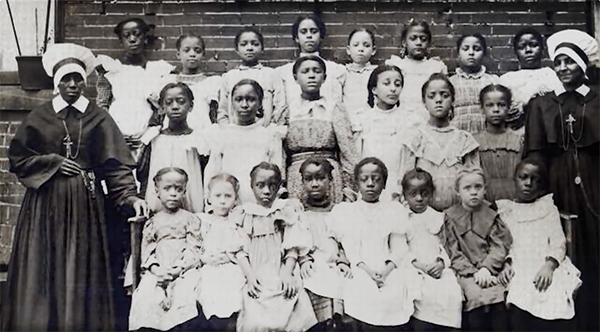
Archbishop Whitfield held fast against the negative culture of his day which refused to acknowledge Blacks as having religious callings, let alone following them. He next allowed Elizabeth and three other Black women to take religious vows of poverty, chastity, and obedience. Under Fr. Joubert’s direction and funding, they founded a Black women’s religious order. Elizabeth became the foundress of the new Oblate Sisters of Providence and their first Mother Superior, taking the name Mary.
Perseverance
When Fr. Joubert died in 1843, the Oblate Sisters lost their main champion and financial supporter. Mother and her Sisters took to begging in the streets for money. They also made and sold altar cloths, and organized fairs.
In 1847, the Oblates gained a new ecclesiastical director in Redemptorist Fr. Thaddeus Anwander, CSsR, considered the congregation’s second founder. Under him, the Sisters opened a school to teach boys and a home for widows. Later they opened missions in Philadelphia (1863) and New Orleans (1867) under the guidance of the Jesuits.
Nearly blind at the end of her life, Mother Lange stepped down as superior in 1876. She died at her convent in Baltimore on Feb. 3, 1882.
The Oblate Sisters of Providence continue their educational mission today in Baltimore; Miami, Florida; Buffalo, New York; and Costa Rica.
Following the call
Despite suffering discrimination throughout her entire life’s work and mission, Mother Lange chose to serve Our Lord, following a call later given by Our Lord Himself to St. Faustina:
Today bring to me the meek and humble souls and the souls of little children, and immerse them in My mercy. These souls most closely resemble My Heart (Diary of Saint Maria Faustina Kowalska, 1220).
Mother Lange’s mercy in serving those least around her, particularly poor children, has resulted in her life being elevated as an example of true Christian living and virtue. As noted on the Oblate Sisters of Providence’s website:
Mother Mary Lange practiced faith to an extraordinary degree. In fact, it was her deep faith which enabled her to persevere against all odds. To her black brothers and sisters she gave herself and her material possessions until she was empty of all but Jesus, whom she shared generously with all by witnessing to His teaching. In close union with Him, she lived through disappointment and opposition until God called her home.
Mother Mary Elizabeth Lange, OSP, pray for us!
{shopmercy-ad}