











God desires that we should share His life, and thus His holiness. Indeed, He commands us: "... be holy, because I am holy" (Lev 11:45). Therefore, the goal of each of us is to be holy: to enjoy the fullness of life through complete union with Him: "Be, therefore, perfect as your heavenly Father is perfect" (Mt 5:48).
Yet one of the greatest complaints of those who have the care of souls is that people who are otherwise true Christians have come to a standstill spiritually and have not advanced beyond the first steps of Christian life and practice. This failure of Christians to progress toward holiness has been a problem since the days of the early Church.
The author of the Epistle to the Hebrews complains how "we are so slow to learn" (Heb 5:11). He goes on to warn that Christians must strive for spiritual perfection because to remain stationary is to risk falling away, never realizing that fullness of life to which they are called.
It seems that we are called to a struggle far beyond our poor capabilities. How are we to persevere, and is there the possibility of success? Indeed there is. In fact, the entire Epistle to the Hebrews is devoted to showing us the way: Our hope, our salvation, our perfection are to be achieved through the priesthood of Jesus, "The Divine Mercy" - the merciful and faithful Great High Priest of the New Covenant. He is God's greatest gift to His creation.
God, however, though He lavishes His gifts most freely upon us, cannot force us to accept them. That is why this one great, unfailing means to perfection, Jesus Christ - the Great High Priest - can be appropriated by us only through a faith of total trust. The power to progress toward maturity in the Christian life comes only through the knowledge of Jesus in His heavenly priesthood. That is, we must come to know Him by experiencing His character, His person, and His mission. We must allow Him to work in us to bring about the inheritance He is waiting to share with us - the Kingdom of Heaven.
But how?
It's All About the 'T' Word
We can do this only if we trust completely in His goodness and mercy. Saint Faustina Kowalska made this telling entry in her spiritual Diary: "Now I know that even [some] souls that are chosen and well advanced in the religious life or the spiritual life do not have the courage to entrust themselves completely to God. And this is so because few souls know the unfathomable mercy of God and His great goodness" (731).
Our Lord often told her of the need for us to trust in His mercy: "Oh, if sinners knew My mercy, they would not perish in such great numbers" (1396); "The graces of My mercy are drawn by means of one vessel only, and that is - trust" (1578); "I desire that these souls distinguish themselves by boundless trust in My mercy. I Myself will attend to the sanctification of such souls. I will provide them with everything they will need to attain sanctity" (1578).
In order to comprehend this goodness and mercy of Jesus (and thus be effectively motivated to believe in it, trust in it, and act upon it), it would be helpful to consider the three stages of His Great High Priesthood:
First: The earthly stage began when He took upon Himself our human nature and became, through His divine person, the only possible bridge between God and us. It ended when He offered Himself, the Perfect Sacrifice, in the Cenacle and on the Cross. This sacrifice accomplished the expiation of our sins and earned us title to His inheritance as the Son of God.
Second:The heavenly stage of Christ's priesthood, which began with His resurrection from the dead and His glorious ascension as the God-man to His Father's throne, is still going on, for "[He] always lives to intercede for us" (Heb 7:25). It is through His heavenly priesthood that we are able to approach with confidence the throne of grace, there to receive His mercy and find the grace we need to "work out our salvation" and arrive at complete union with Him.
Third: He will enter the final stage of His priesthood when He comes again to judge the living and the dead. At this time He will bring His Body, the Church, to perfection by deifying it:
... and He will live with them. They will be His people, and God Himself will be with them and be their God. ... There will be no more death or mourning or crying or pain, for the old order of things [shall] have passed away. (Rev 21:2-4).
Prepare for the Celebration
According to the author of Hebrews, Christ's act of reparation is so powerful that believers who persevere in union with Him will not crouch in fear before Him when He returns as Judge and Lord. On the contrary, they will lift up their heads and cry out: "Maran atha!" (Our Lord, come!) They will experience Christ's return as a "Calling of the Just" and a celebration. It will be a time when God will express to them His gratitude for allowing Him to fulfill His loving purposes in them.
Through the many revelations He granted to St. Faustina, our Lord is attempting to focus the Church's attention upon these truths of His holy priesthood in order to prepare the world for His return. As St. Faustina records in her Diary, our Lord commanded her:
"Write down these words, My daughter. Speak to the world about My mercy; let all mankind recognize My unfathomable mercy. It is a sign for the end times; after it will come the day of justice. While there is still time, let them have recourse to the fount of My mercy; let them profit from the Blood and Water which gushed forth for them" (848).
The Blood and Water that gushed forth from Christ's pierced side is, above all, the symbol of His life poured out for His brothers: "I will give him a portion among the great ... because he poured out his life unto death" (Is 53:12). "After the suffering of his soul, he will see the light of life, and be satisfied; by knowledge of him my righteous servant will justify many" (Is 53:11).
"Justify" means that sin is removed and union with the Holy God is reestablished. This could be done only by a priest offering the blood of atonement. What Jesus implied to St. Faustina is that, by His poured-out life, He is the Priest as well as the Atoning Sacrifice that expiated our sinfulness and opened to us the channel of grace and divine life. This is the great mercy imparted to sinful humanity. Since the "Offerer" and the "Offering" are one and the same Divine Person - Jesus - who was constituted priest by His Father through the Incarnation and the Passion, He can rightfully be titled the Great High Priest, "The Great Mercy."
What's in the Image?
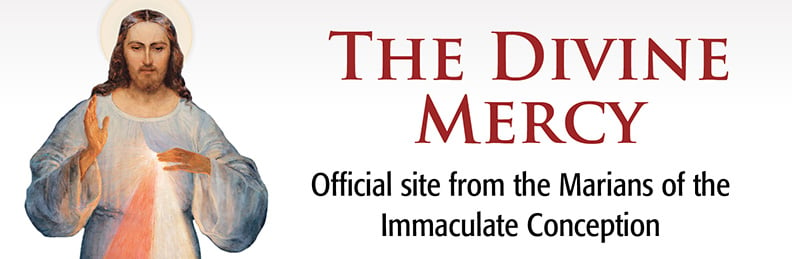
An important vision granted to St. Faustina corroborates this conclusion. In it she was given to see Jesus, just as He is depicted on the now-famous Image of The Divine Mercy that she was told by Him to paint.
He was wearing a white tunic and emitting the red and pale rays that represent the Blood and Water of His life poured out, and He was entering a dwelling of light to which there were three doors.
This is a clear allusion to the high priest of the Old Covenant, who on the Day of Atonement entered the Tent of The Covenant to offer the sprinkled blood for remission of sins. In Christ's case, however, the blood is His own. The Old Testament priest went in beyond the veil at the jeopardy of his life. If he came out alive, the people knew this was their assurance of sins forgiven.
Jesus came out alive, resurrected from the dead, and announced peace and the forgiveness of sin. But then only those who believed in Him saw Him. When He returns again with the clouds, "every eye will see Him, even those who pierced Him" (Rev 1:7). Then He will come not to deal with sin, which was done once and for all by His self-offering, but to bestow salvation on those who are eagerly awaiting His coming in faith, trust, and vigilance (see Heb 9:28).
The image of The Divine Mercy given to St. Faustina is, therefore, a succinct representation of the three stages of the priesthood of Christ. His earthly ministry is represented by the wounds to His human person that attest to His sacrifice. His ankle length (priestly) tunic and the rays, here denoting His blood sprinkled in heaven, represent His heavenly priesthood as He continues to intercede for us. His hand upraised in absolution, blessing and welcome, represents His priesthood when He comes again. This time the rays are seen as arrows pointing to the Heart of the Lord. A powerful symbol of how Christ continues to sanctify us through His presence in the Sacraments, they lead us into the heart of the Temple in which God delights to dwell.
The inscription on the image, "Jesus, I Trust in You," indicates that it is the knowledge of Christ in His heavenly priesthood that is capable of eliciting in us that trust through which Jesus, The Divine Mercy, will bring us to the fullness of salvation.
Be confident!
Jesus tells St. Faustina, "Tell [all people], My daughter, that I am Love and Mercy itself. When a soul approaches Me with trust, I fill it with such an abundance of graces that it cannot contain them within itself but radiates them to other souls (Diary, 1074).
He continues, telling her, "Write this: Everything that exists is enclosed in the bowels of My mercy, more deeply than an infant in its mother's womb. How painfully distrust of My goodness wounds Me!'" (1076).
And so, to achieve the fullness of life that we are promised, the holiness we are commanded to attain, "let us then approach the throne of grace with confidence, so that we may receive mercy and find grace to help us in our time of need" (Heb 4:6).
Father Seraphim Michalenko, MIC, served as vice-postulator in North America for St. Faustina's canonization cause. He lives on Eden Hill in Stockbridge, Mass.