













“It was said that I would be the only priest of my race in America and would not likely succeed,” Fr. Augustus recalled. “Everyone received me kindly, especially the Negroes, but also the White people: Germans, Irish, and all the others."
Welcome to a new series, "The Venerables": Holy men and women in the United States, in some cases little-known, who are on the road to sainthood. The road to sainthood has four steps: "Servant of God," "Venerable," "Blessed," and "Saint." The Pope grants the title "Venerable" after a review confirms the individual has lived a life of heroic virtue. The next step, beatification, requires the verification of a miracle attributed to their intercession.
By Kimberly Bruce
“It was said that I would be the only priest of my race in America and would not likely succeed.”
So said Venerable Fr. Augustus Tolton, the first African-American diocesan priest in the United States, a former slave who founded the first black Catholic church in Chicago, Illinois.
Not only was the statement untrue, but Fr. Tolton is now on the road to sainthood. In 2019, he was declared Venerable by Pope Francis.
“Father Tolton’s holiness comes from his patient suffering, his brave spirit, and his pastoral heart for all who came to him,” said Cardinal Blasé Cupich, archbishop of Chicago. “His struggles to become a priest and his remarkable service to God’s people are admirable examples, particularly in these times of the value and dignity of every person.”
Born into slavery
John Augustus Tolton was born into slavery in Rails County, Missouri, on Apr. 1, 1854. The Tolton family was Catholic. Peter Tolton, Augustus' father, joined the Union Army during the Civil War to fight for freedom; he died in action.
In 1863, Augustus escaped as a 9-year-old with his mother and his two siblings in a boat his mother rowed across the Mississippi River to freedom in Illinois. During their escape, they were pursued and shot at by Confederate soldiers.
Upon landing in Quincy, Illinois, Augustus’ mother fell to her knees with her children and said, “Now you are free; never forget the goodness of the Lord.”
Discrimination
Augustus went to work in a tobacco factory. Freed slaves still faced discrimination in the North, and it took five years for Augustus to be enrolled in a school that would accept him: St. Peter’s Catholic School.
A mild-mannered young man, Augustus exhibited kindness and gentleness. Despite all the prejudices he had suffered in his life, he never harbored any unforgiveness towards anyone. He treated all, black and white, with goodness, and he had a sincere desire to serve all with the love of Christ.
Priests and nuns took notice, and Augustus ("Gus") became a catechist, teaching religion classes to black children, and was an altar server at Mass.
Discerning a call to the priesthood, he was refused entrance into any seminary in the U.S. because of his race. Augustus took his hardships, disappointments, and all his sufferings to prayer, waiting and hoping for things to change. Appropriate words written from St. Faustina show us the value of such sufferings:
True love is measured by the thermometer of suffering. Jesus, I thank You for the little daily crosses, for opposition to my endeavors, for the hardships of communal life, for the misinterpretation of my intentions, for humiliations at the hands of others, for the harsh way in which we are treated, for false suspicions, for poor health and loss of strength, for self-denial, for dying to myself, for lack of recognition in everything, for the upsetting of all my plans (Diary of Saint Maria Faustina Kowalska, 343).
Priesthood
Undeterred, Augustus enrolled in St. Francis Solanus College (now Quincy University) in 1878, and graduated two years later as valedictorian of his class. His professors helped him gain admission to the Pontifical Urban University in Rome. This university specifically trained future priests to be missionaries and focused on learning languages and understanding cultures.
Augustus did well and was loved by his classmates and professors. Having mastered German from his childhood in Illinois, he picked up Latin, French, and Italian. He fully expected after ordination to be a missionary and sent out into the world.
Ordained to the priesthood on April 24, 1886 in the Basilica of St. John Lateran, Fr. Augustus celebrated his first Mass the next day, Easter Sunday, in St. Peter’s Basilica. But then the unexpected happened.
Mission to America
Cardinal Giovanni Simeoni, the prefect of the Congregation for the Propagation of the Faith, saw an opportunity to address his concerns about the mission church in the United States and its outreach to emancipated slaves. He directed Fr. Augustus to return home and serve as a missionary to the black Catholic community!
“America has been called the most enlightened nation; we’ll see if it deserves that honor,” Cardinal Simeoni said. “If America has never seen a black priest it has to see one now!”
“It was said that I would be the only priest of my race in America and would not likely succeed,” Fr. Augustus recalled. Upon his return home to Quincy, he wrote, “Everyone received me kindly, especially the Negroes, but also the White people: Germans, Irish, and all the others. I celebrated Mass on July 18, in the Church of Saint Boniface, with more than 1,000 whites and 500 colored people present.”
Father Augustus spent three years at St. Boniface in Quincy until, at the invitation of Archbishop Patrick Feehan, he arrived in 1889 in Chicago to minister to black Catholics. There he launched a new parish, St. Monica’s, on the corner of 36th and Dearborn Streets.
Pioneer
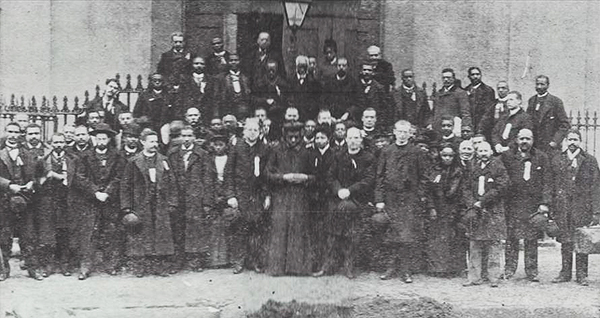
Saint Monica’s grew from 30 parishioners to more than 600. “Good Father Gus” was praised for his “eloquent sermons, his beautiful singing voice, and his talent for playing the accordian.” He attended the first-ever Colored Catholic Congress in Washington, D.C. in 1889 and celebrated Mass. Congress organizer Daniel Rudd wrote:
For a long time the idea prevailed that the negro was not wanted beyond the altar rail, and for that reason, no doubt, hundreds of young colored men who would otherwise be officiating at the altar rail today have entered other walks. Now that this mistaken idea has been dispelled by the advent of one full-blooded negro priest, the Rev. Augustus Tolton, many more have entered the seminaries in this country and Europe.
Father Augustus continued to work amongst the poor black and largely former slave population in Chicago until his death from heatstroke at age 43 in 1897. He was buried in Quincy, at his request, in St. Peter’s Cemetery.
“Augustus Tolton is a pioneer African American Catholic,” wrote the diocesan postulator for the cause of Fr. Augustus’ canonization, Bishop Joseph N. Perry. “His modeling shows us how to witness to the Gospel in the midst of racial tension and instances of racial hatred that erupt still from time to time.”
Venerable Fr. Augustus Tolton, pray for us!
Learn more about Venerable Fr. Tolton here.
{shopmercy-ad}