













“In moments of stress, in moments of tension, in moments of a lot of expectation, a lot of pressure, you're representing your whole country. Immediately, you look up to Heaven, and there's nothing more beautiful."
Welcome to "Fields Full of Grace: The Faith at Play," casting a spotlight on the devotional practices of college and professional athletes and coaches on and off the field.
By Jay Sorgi
It was started by a devout Catholic. Its main characters in the final act included arguably its greatest player sharing the Sign of the Cross before what may have been his own final stanza on the world’s biggest stage. His teammate wore an image of the Blessed Virgin Mary on his shin guard during the tournament. And a team led by a devout Catholic earned one of its nation’s hardest-fought, most glorious sporting victories, with a fellow Catholic scoring the championship-winning goal.
It’s the FIFA Men’s World Cup.
The 2026 tournament, the world’s most-watched sporting event, has come to a close after 39 days in the U.S., Canada, and Mexico, but not without countless moments of surprise, of the kind of unexpected encounter between cultures and countless examples of missionary discipleship through word and action as billions watched.
Brotherhood of humanity
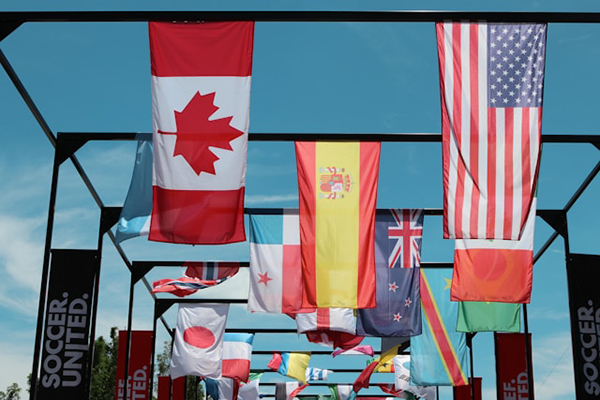
“It was like experiencing the brotherhood of humanity of different nations,” recalled Fr. Remigio Morales, pastor of Sts. Agatha and James Parish in Philadelphia, Pennsylvania, and servant-leader to students at Drexel University and the University of Pennsylvania through their Newman Centers. He was gifted a ticket by a friend to the June 27 match between Croatia and Ghana. He observed that a similar feeling comes upon him whenever he celebrates Mass.
“When you go to Mass, you're all united, all the nations, all the tongues contemplating the Eucharist,” he said.
It’s the type of world-connecting moment that a Catholic man named Jules Rimet may have dreamed of when he conceptualized the World Cup. The Frenchman had previously started teams before co-launching FIFA, the governing body of soccer, in 1904.
Nine years after his presidency of the organization began in 1921, the first World Cup gathered teams from all over the world in Uruguay, including Team USA, which made the semifinals.
Papal inspiration
Rimet’s inspiration came from Pope Leo XIII’s Rerum Novarum, the 1893 encyclical which called the Church to better stand beside the world's poor and meet their needs.
Just a few years before Rerum Novarum, a priest in Glasgow, Scotland who belonged to the Society of Mary used the game to do just that. Brother Walfrid needed a way to help meet the needs of the Catholic poor on the city’s East End.
“A football club will be formed for the maintenance of dinner tables for the children and the unemployed,” he said. He formed Celtic Football Club, taking advantage of the relatively new sport of association football to do just that. Celtic became one of the most successful clubs in Europe in the last sixty years, yet has kept its Catholic identity strong.
The sport has kept strong Catholic roots, as 18 of the combined 32 winners of the men’s and women’s World Cups have come from five nations among the 10 most Catholic-populous countries in the world: Brazil (with devout Catholic Pelé), Italy, France, Spain, and the United States.
Argentine faith
World Cup finalist Argentina, another majority-Catholic nation (where the Marian Fathers are active in parish and school ministries), boasted Lionel Messi who is arguably the greatest to ever play the sport. The number of Signs of the Cross he made on a World Cup pitch exceeded even his prodigious goal-scoring, after which he has made the faithful gesture a tradition.
His teammate, Lautaro Martínez, wore a card of Our Lady of Lujan, the patron saint of Argentina, on his lower leg during postgame news conferences following Argentina’s win over Egypt on July 7.
The England vs. Argentina semifinal match on July 15 found Marians rooting for both sides, as the new Marian Centre for Catholic Life is starting in London. England lost that one, but performed spectacularly against France to clinch the third-place title.
Father Alex Pumphrey, MIC, watched the match from a unique perspective. As a seminarian, he served in Argentina. Now he is based in London. Where did his loyalties lie?
“I must admit, I was rooting for both sides,” he said. “There was certainly much disappointment and soul-searching over here at England’s loss, as I imagine there was in Argentina. At the end of the day, we always pray for good sportsmanship and fellowship.”
Is it okay to pray to God or Our Lady for a win?
"It's best not to ask to win,” Fr. Alex said. “Rather, pray that your team may do their very best with their God-given talents, and behave like a team that is worthy of winning, with good sportsmanship, no matter what the final score may be. If they do both of those things, they are "winners" on the only scoreboard that really matters: the one in Heaven!”
Praying not just for victory
Luis de la Fuente, the Catholic general manager of FIFA world champions Spain, also voiced his daily prayerful communion with God during the tournament, sharing that he didn’t pray for victory but for greater things like health and the gift of enjoying the life God gave him.
“I give thanks for those little things,” he said. “I pray because I pray every day, not so that He will help me more.”
Ferrán Torres, the man who clinched Spain’s second World Cup men’s title, also shared his Catholic faith both before and after his goal in the second period of extra time that gave them a 1-0 win over Argentina on July 19.
“I have a cross and an image of the Virgin Mary,” he said. “Ultimately, I think having such strong faith gives me great support — it is something very important to me.”
Public witness
“Sport provides such a platform for public witness,” observed Dr. Jay Carney, an author on the subject of faith and sports and the chair of Catholic theological studies at Creighton University. “Athletes are in a unique position to evangelize and even to be witnesses to their faith, what Saint John Paul II described as a kind of helping to form a civilization of love.”
Ultimately, that’s what billions of soccer lovers like Fr. Morales get to create by connecting into oneness through what’s called “the beautiful game,” one that he loves for the game itself and the opportunity for its stars to direct the world toward Jesus.
“In moments of stress, in moments of tension, in moments of a lot of expectation, a lot of pressure, you're representing your whole country. Immediately, you look up to Heaven, and there's nothing more beautiful,” Fr. Morales said. “I want the young people in the world to stop and contemplate that and realize it. Your soccer stars are doing that. God exists.”
Photos by Fauzan Saari and Waseem R on Unsplash.
{shopmercy-ad}