











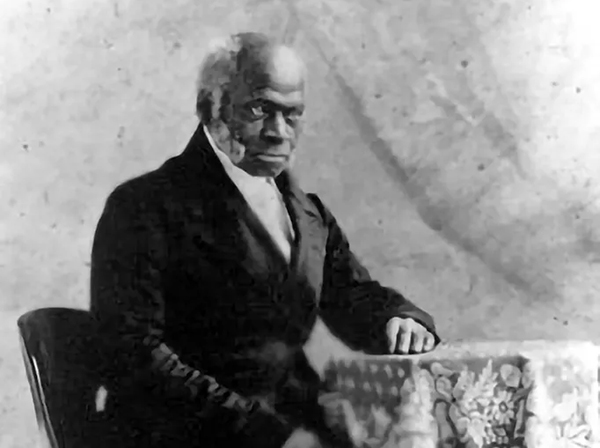
A portrait of Venerable Pierre Toussaint in St. Patrick's Cathedral in New York City, where he is buried.
“Working well into old age, when Pierre was questioned by a woman as to why he, such a wealthy man, kept working, he responded, “Then, Madame, I should not have enough for others.”
Welcome to a new series, "The Venerables": Holy men and women in the United States, in some cases little-known, who are on the road to sainthood. The road to sainthood has four steps: "Servant of God," "Venerable," "Blessed," and "Saint." The Pope grants the title "Venerable" after a review confirms the individual has lived a life of heroic virtue. The next step, beatification, requires the verification of a miracle attributed to their intercession.
By Kimberly Bruce
Our Catholic faith teaches us that we are all called to be saints, whatever our circumstances. Consider the example of a former slave and hairdresser who became a great philanthropist and inspired the work of Catholic Charities in New York City.
His name is Pierre Toussaint. Declared Venerable by Pope St. John Paul II in 1997, Pierre is the only lay person buried among the cardinals and bishops in the crypt of St. Patrick’s Cathedral.
From Haiti to New York
Pierre was born into slavery on June 27, 1766 in the French colony of Saint-Domingue, in what is today Haiti. He worked in the house of the Bérard family, who treated him kindly. His Master, Jean Berard, a Catholic, even encouraged young Pierre to learn to read and write and freely avail himself of the Berard personal library.
In 1797 the family left Haiti for New York City, taking Pierre with them. Jean Bérard arranged for Pierre to be taught the art of hairdressing by one of the city’s most prominent hairdressers. Pierre learned quickly and had a knack for mastering the complicated hairstyles of his day. For such coiffure, wealthy ladies paid $1,000 yearly. Jean allowed Pierre to keep a portion of his earnings.
Well-loved by his clientele, Pierre was a kind, courteous, and skilled hairdresser in possession of grace and wit. He refused to gossip, despite being forever goaded into telling what he knew of others. To one particularly known gossip, he responded, “The man is a hairdresser. He is no news journal.”
Saint Faustina spoke of such a mark of holiness in her Diary, saying:
The Holy Spirit does not speak to a soul that is distracted and garrulous, He speaks by His quiet inspirations to a soul that is recollected, to a soul that knows how to keep silence. If silence were strictly observed, there would not be any grumbling, bitterness, slandering, or gossip, and charity would not be tarnished … Silent lips are pure gold and bear witness to holiness within (Diary of Saint Maria Faustina Kowalska, 552).
Hard times
Jean Bérard brought money from Haiti to support his household for a year in America. Never thinking tumultuous times in Haiti would extend for longer than that, the Berards ran out of money. Jean returned to Haiti to check on his plantation.
But Haiti was in turmoil, with slaves turning on their masters. Amid the violence and chaos, the Berard plantation was destroyed. Jean succumbed to pleurisy and died.
Back in America, Madame Bérard requested that Pierre sell her jewels to pay a debt. He returned her jewels a few days later, saying, “It was not necessary, Madame. I had some money left over from my work. Also, I did not spend the generous New Year’s present you gave me.” He continued, “My work is going very well, and I would like to arrange to provide a certain sum each week for household expenses until these financial difficulties pass.”
And so, Pierre took over the expenditures of his late master’s household in a completely benevolent act. He never spent a penny on anything for himself until all household expenses and even little luxuries for those therein were taken care of. Outsiders never knew it was Pierre who was supporting the Berard household.
Pierre attended Mass each morning at 6 o’clock at St. Peter’s Church on Barclay St., the same church attended by Mother (and future saint) Elizabeth Ann Seton. Due to racism, he was not allowed to ride in a carriage, so he walked from one client’s home to the next for work. All loved seeing the cheerful Pierre walking the streets of New York during his 16-hour days.
Freedom
In 1807, before Madame Marie died, she declared Pierre his freedom. Pierre then purchased the freedoms of his sister and a friend, Juliette Noel, whom he married.
The couple gave themselves, unreservedly, to serving those neediest around them. Operating a kind of Catholic Charities, they were the perfect example of Christian charity to orphans, refugees, and the poor. Pierre also helped secure employment for those out of work and tutored many children. He passionately supported the Oblate Sisters of Providence, an order of black women established in 1829, and St. Vincent de Paul, the first Catholic school for black children in New York City.
When a plague struck the city of New York, Pierre helped fund a Catholic orphanage run by three of Mother Seton’s Sisters of Charity in 1817. He visited the homes of plague-stricken individuals, abandoned with no one to care for them, and tended to their needs despite the risks to himself.
Working well into old age, when Pierre was questioned by a woman as to why he, such a wealthy man, kept working, he responded, “Then, Madame, I should not have enough for others.”
Pierre lost his beloved Juliette in 1851. Heartbroken, he died two years later, on June 30, 1853. He was buried beside Juliette in Old St. Patrick’s Cemetery on Mott Street.
Awed by holiness
In 1989, Cardinal John O’Connor had Pierre’s remains relocated to the vault beneath the altar of St. Patrick’s Cathedral. He said:
[Pierre] is now buried beneath this high altar with all of the bishops, archbishops and cardinals of New York. It will be a great privilege for me to be buried in a vault in the same section with Pierre Toussaint … If ever a man was truly free, it was Pierre Toussaint. …If ever a man was a saint, in my judgment, it was Piere Toussaint. …No one can read this man’s life—and the records are thoroughly authentic—without being awed by his holiness.
If each of us would take one virtuous example from Ven. Pierre’s life and weave it into our own, we would grow in holiness. Putting others before ourselves, possessing a cheerful spirit, being generous to those in need, or refraining from complaints and gossip, liken us more to The Master, Christ, Our Lord.
Venerable Pierre Toussaint, pray for us as we seek to become more holy!
{shopmercy-ad}