











Before bulk mailing rates, before the Internet and email, before television mass appeals, Father Baker sat down night after night and hand wrote thousands of letters to postmasters all over the country, asking them to send him names of a few Catholic women who liked to engage in charitable work in their cities and towns.
Welcome to a new series, "The Venerables": Holy men and women in the United States, in some cases little-known, who are on the road to sainthood. The road to sainthood has four steps: "Servant of God," "Venerable," "Blessed," and "Saint." The Pope grants the title "Venerable" after a review confirms the individual has lived a life of heroic virtue. The next step, beatification, requires the verification of a miracle attributed to their intercession.
By Kimberly Bruce
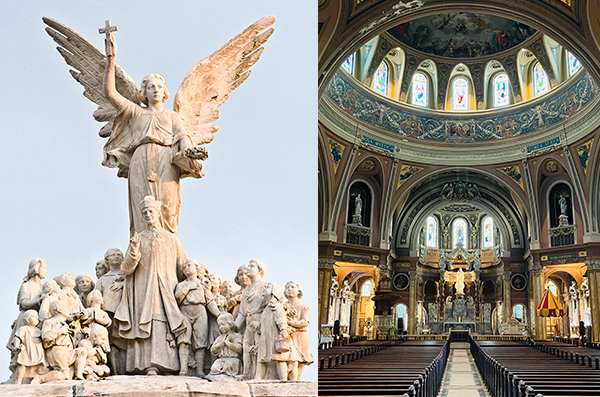
The next time you pass through Buffalo, New York, on your way to Niagara Falls, pause to gaze upon a truly breathtaking site: Our Lady of Victory National Shrine and Basilica. Inside the vast ornate interior is the grave of the priest who spearheaded the construction: Fr. Nelson Baker.
Declared “Venerable” on Jan. 14, 2011, by Pope Benedict XVI, Fr. Baker was described by the bishop of Buffalo as “a simple diocesan priest, whose devotion to Our Lady of Victory and service to the least among us was extraordinary.”
Hearing the call
Born on Feb. 16, 1842, in Buffalo, Nelson was raised by a Lutheran father and Catholic mother. His father owned a grocery store where Nelson and his three brothers worked. Nelson loved accompanying his devout mother to Mass.
After serving in the Union Army during the Civil War, Nelson started a successful feed and grain business with a friend. As a member of the St. Vincent de Paul Society as well as being a Sunday school teacher, Nelson found himself wondering if he was called to the priesthood.
He discussed his possible vocation with a local priest, and, not long after, entered Our Lady of the Angels Seminary (now Niagara University) in Lewiston, New York, at age 27. He had a brush with death from a leg infection, but recovered. He was ordained to the priesthood in 1876.
Father Nelson had a strong devotion to Mary, especially Our Lady of Victory. His devotion began while on pilgrimage to Our Lady of Victories Shrine in Paris, France as a seminarian. He decided then to establish devotion to Our Blessed Mother as Our Lady of Victory in the United States, a dream he would realize in grand fashion.
Helping orphans
Father Nelson’s first assignment was to two church institutions for orphans, St. John’s Protectory and St. Joseph Boys’ Orphan Asylum. Both were massively in debt and threatened with closure. As superintendent, Fr. Baker decided to tackle the situation head-on with all the strength and wits he could to raise funds.
He became a mastermind at the use of direct-mail campaigns to raise funds for his orphanages from across the United States. As explained on Catholicism.org:
Before bulk mailing rates, before the Internet and email, before television mass appeals, Father Baker sat down night after night and hand wrote thousands of letters to postmasters all over the country, asking them to send him names of a few Catholic women who liked to engage in charitable work in their cities and towns. As these names came in, he wrote these ladies, appealing to their sense of Christian charity and their desire to keep Catholic orphan children from being lost to the Faith by being sent to secular institutions. He asked for one quarter a year — twenty-five cents — in membership dues. In return, they would be prayed for at Masses at the major Marian shrines of Europe, including Our Lady of Victories in Paris.
Money poured in, and Father was able to get the institutions out of debt. He then set to work building other structures needed on the property, including an expanded chapel. Every day, he led the orphans in giving “three cheers” to Our Lady of Victory.
With the institutions on better financial footing, Fr. Nelson turned his attention to education. It was important to teach the boys skills so they could earn a living after leaving the orphanages. He taught them how to farm, make shoes, cut hair, bake, and cook.
Helping unwed mothers
One experience affected Fr. Nelson Baker gravely and took his charitable works to another level. During construction of the Erie Canal through New York State, dredging the river revealed the remains of babies and young children. It was discovered that unwed mothers often drowned their children to keep from becoming societal outcasts and subject to abject poverty. At that time, unwed mothers were often thrown out into the streets, even by their own families.
Horrified, Fr. Baker opened the Our Lady of Victory Infant Home for mothers and their babies. He had a no-questions-asked policy regarding the mothers-to-be who came to his shelter.
Even though Father took some heat from townspeople about this new home, it soon filled with residents and began to change the culture of their city.
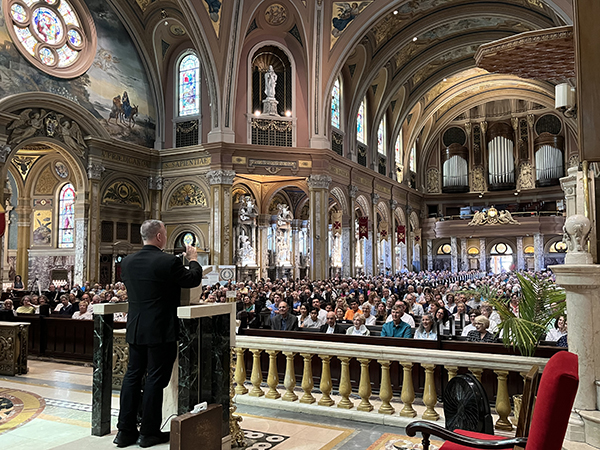
Father did not stop there. He built a maternity hospital in 1919 and the first black Catholic parish in his neighborhood. At age 84, in May 1926, he finally completed his life’s dream: He opened the magnificent Our Lady of Victory Shrine, designated a basilica by Pope Pius XI that same year.
Padre of the Poor
When the Great Depression hit in 1929, now-Monsignor Nelson, referred to as the “Padre of the Poor,” poured his energies into helping feed several hundred thousand people through his institutions. He additionally provided medical care for an estimated 250,000 people and clothing for 500,000.
Monsignor Nelson met the needs of those most in need around him: the poor; children; unwed mothers. He had concern for them like St. Faustina, who prayed:
Most merciful Jesus, I beseech You through the intercession of Your Saints, and especially the intercession of Your dearest Mother who nurtured You from childhood, bless my native land. I beg You, Jesus, look not on our sins, but on the tears of little children, on the hunger and cold they suffer (Diary of Saint Maria Faustina Kowalska, 286).
At the age of 94, on July 29, 1936, Msgr. Nelson died. His funeral was attended by half a million people. His body was moved to Our Lady of Victory Basilica in 1999, and his blood, which had been placed in a small casket atop his coffin at the time of his original burial, was still liquified. A museum telling Msgr. Nelson’s story is in the lower level of the basilica.
Today, Ven. Msgr. Nelson Baker’s good works continue through OLV Human Services which cares for thousands of children and families each year.
Venerable Msgr. Nelson Baker, priest of charity and mercy, pray for us!
{shopmercy-ad}