












The goal of Mother Mary Alphonsa, Superior of her new Order, was to “take the lowest class both in poverty and suffering [the cancerous poor] and put them in such a condition, that if Our Lord knocked at the door we would not be ashamed to show what we had done.”
Welcome to "The Venerables": Holy men and women in the United States, in some cases little-known, who are on the road to sainthood. The road to sainthood has four steps: "Servant of God," "Venerable," "Blessed," and "Saint." The Pope grants the title "Venerable" after a review confirms the individual has lived a life of heroic virtue. The next step, beatification, requires the verification of a miracle attributed to their intercession.
By Kimberly Bruce
Who knew that the daughter of a great American author, who grew up a stone’s throw from the present-day National Shrine of The Divine Mercy, is now on the road to sainthood?
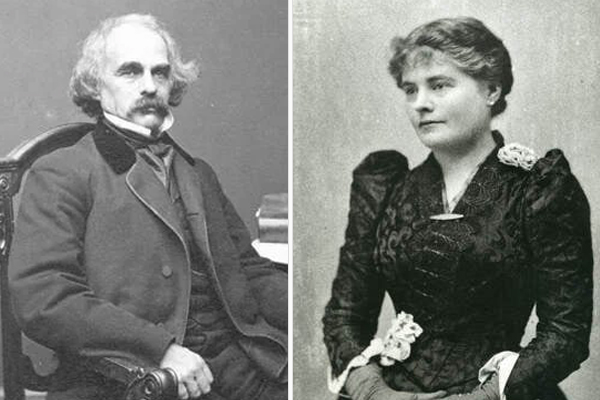
Here name is Mother Mary Alphonsa, OP, born Rose Hawthorne, the daughter of Nathaniel Hawthorne, who wrote the classic novel The Scarlet Letter.
In 2024, Rose, a wife, mother, convert, widow, nun, nurse, and champion of the poor and those suffering with cancer, was declared “Venerable” by Pope Francis for having led a life of heroic faith, hope, and charity with justice, temperance, prudence, and fortitude.
Privileged childhood
The Hawthornes lived in a red “cottage” on the border of present-day Stockbridge and Lenox, Massachusetts, from August 1850 to November 1851. Rose was born on May 20, 1851, the third and last child of Hawthorne and Sophia Peabody.
The original cottage burned down in 1890, but a “re-creation” of it sits behind the world-famous Tanglewood concert venue.
When Rose was a young girl, she moved with her family to Liverpool, England where her father accepted a diplomatic position from U.S. President Franklin Pierce. The Hawthornes were not Catholic, but Rose was exposed to Catholicism through her family’s travels in Europe. She also saw the Catholic faith exemplified in her family’s servants.
Seeing Bl. Pope Pius IX in Rome during Holy Week, she recalled, “I became eloquent about the Pope, and was rewarded by a gift from my mother of a little medallion of him and a gold scudo [coin] with an excellent likeness thereon, both always tenderly reverenced by me.”
But Rose and her siblings were baptized in the Unitarian Church by their parents before returning home to Massachusetts. The Hawthornes had a deep devotion to God, read the Bible as a family, and even read together The Imitation of Christ by Thomas à Kempis.
Marriage and motherhood
Nathaniel died in 1864, a day before Rose turned 13. A family friend provided for Rose’s schooling. Sophia, already seeing in her daughter a love for God and desire to help her fellow human beings, penned a letter to Rose on her 16th birthday:
I knew that religious principle and sentiment would surely render you at last gentle and charitable to the shortcomings of your fellow mortals. …And this will lead you to the heights of being at last. …I have always felt that it was most important for such a mind and character as yours that you should be truly religious. GOD alone can rule in your heart. …But you must have the highest motives for action.
In 1868, Sophia moved her family to Dresden, Germany. Rose was, again, exposed to the Catholic faith in a new country. She met and befriended George Lathrop, from another American family living there, and they married.
It was not a happy marriage. Their son, Francis, died from diphtheria at age 4. George, although a faithful husband, changed jobs frequently, and had a temper and a drinking problem. Nevertheless, both George and Rose converted to Catholicism in 1891.
Separation and service
Rose eventually sought a formal separation from her husband because of George’s violent behavior and fear for her own safety. She never went so far as to seek divorce, but the two lived separately. She acknowledged that if her bishop had told her to stay with her husband, she would have, but she was clear to say that she did not believe their living together would have been good for her husband’s soul.
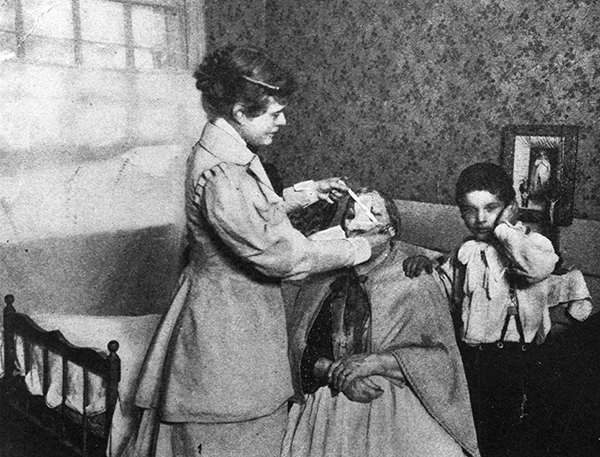
In 1896, Rose began a new chapter by moving to New York City where she immersed herself in the works of mercy, caring for the poor and the sick while training as a nurse at the New York Cancer Hospital. George died two years later, and Rose began the St. Rose’s Free Home for Incurable Cancer, named after St. Rose of Lima.
Inspired by a young Dominican priest, Rose became a third-order Dominican and, taking the name Mary Alphonsa, went on to found the Dominican Sisters of Hawthorne, Congregation of St. Rose of Lima. This congregation was dedicated to caring, free of charge, for those with cancer, then thought to be a contagious disease. On Dec. 8, 1900, the Feast of the Immaculate Conception, Archbishop Michael Corrigan of New York approved the new community of Dominican Sisters.
The goal of Mother Mary Alphonsa, now Superior of her new Order, was to “take the lowest class both in poverty and suffering [the cancerous poor] and put them in such a condition, that if Our Lord knocked at the door we would not be ashamed to show what we had done.”
Sacrifice is imperative
Mother was very devoted to the Eucharist and to the Blessed Virgin Mary. She expressed, “There can be no fervor without sacrifice; and the greater the sacrifice the greater the fervor. Since this heat is required of us, before we can serve God, the sacrifice is imperative; and a holocaust of all that we can sacrifice, because the Master we serve deserves great offerings.”
Mother Alphonsa sounds a lot like St. Faustina, who said:
I will empty myself before You; my pure and undivided love will burn, in profound silence, as a holocaust. And may the fragrance of my love be wafted to the foot of Your throne (Diary of Saint Maria Faustina Kowalska, 1564).
As women began to join Mother’s community, more houses for caring for the sick were opened, beginning with Rosary Hill Home in Westchester County, New York in 1901. Shortly after this home opened, the town renamed itself “Hawthorne” in Mother’s honor. Five more homes followed.
Mother worked diligently in her homes until her death on July 9, 1926, at the age of 75. She is buried at the motherhouse in Hawthorne, New York. Today, the Rosary Hill Home thrives, as well as homes in Philadelphia, Pennsylvania, and Atlanta, Georgia, and free care is still offered to those in financial need.
May we seek to love others so much that we give ourselves, according to our state in life, over to the service of others as Mother Mary Alphonsa did.
Venerable Servant of God Rose Hawthorne, pray for us!
Learn more about Rose Hawthorne here.
{shopmercy-ad}