










Father Schwartz “didn’t just want to help [the poor] — he wanted to give them the best that he could. They had enough suffering. He said, ‘You want the best for your children; I want the best for my children.’ That’s the philosophy that he had.”
Welcome to "The Venerables": Holy men and women in the United States, in some cases little-known, who are on the road to sainthood. The road to sainthood has four steps: "Servant of God," "Venerable," "Blessed," and "Saint." The Pope grants the title "Venerable" after a review confirms the individual has lived a life of heroic virtue. The next step, beatification, requires the verification of a miracle attributed to their intercession.
By Kimberly Bruce
Not many Catholic priests can claim to have changed the course of a country’s history, nor to have been nominated for the Nobel Peace Prize – twice! In the case of Venerable Fr. Aloysius Schwartz (1930-1992), he had an immeasurable impact on the people of South Korea, bringing healing and peace to a nation still suffering from the ravages of the Korean War.
Father Schwartz, despite suffering from ALS (Lou Gehrig’s disease) during the final years of his life, founded hospitals, clinics, schools, orphanages, and Boys and Girls Towns across the country, as well as founding religious orders such as the Sisters of Mary and the Society of the Brothers of Christ.
A contemporary described this tireless priest best: “Fr. Al Schwartz was the boldest man I ever knew. He feared no one. … The only thing Fr. Al feared, perhaps, was disappointing the Virgin Mary, to whom he had consecrated his priesthood … He fought relentlessly for the poor on behalf of his Queen, the Virgin of the Poor.”
Early determination
Aloysius was born in Washington, D.C., on Sept. 18, 1930, the third of seven children. He knew early on that he wanted to be a priest and missionary, inspired by the DC Comics series Boy Commandos about heroes travelling the world to help the poor.
“Since the fourth grade in grammar school, I have been waiting to leave for the missions,” he wrote to his sister, Delores. “And the older I get the more intense becomes this desire. It’s only natural but we learn so much by patience. It purifies everything in our selfish hearts and leaves us clean before God.”
Aloysius joined the Maryknoll Fathers, an order of missionary priests, and attended Maryknoll College. While studying at Louvain University in Belgium, he visited the apparition site of Our Lady of Banneux, the Virgin of the Poor. There he vowed to Mary that he would be her “slave” in service to the poor.
He was ordained in 1957 for his home diocese in Washington, D.C., and shortly afterwards petitioned his bishop to be sent to South Korea.
Rocky start
Father Aloysius encountered devastation everywhere on the Korean Peninsula. Thousands had fled their homes, poverty was widespread, and the number of orphans was enormous.
Like his flock, Father suffered from cold, exhaustion, and lack of food, and could not speak the language. Two months into his ministry, he collapsed at Mass. Diagnosed with hepatitis and intestinal problems, he returned to the U.S. for treatment.
On the home front, he wasted no time fundraising for his mission, starting a non-profit direct-mail campaign called Korean Relief, Inc.
Returning to South Korea in 1961, Father became the pastor of one of the poorest parishes in Busan. He built himself a shack, living in poverty amidst his parishioners for the next three years.
According to his sister, Father “didn’t just want to help [the poor] — he wanted to give them the best that he could. They had enough suffering. … He said, ‘You want the best for your children; I want the best for my children.’ That’s the philosophy that he had.”
Two things to ask
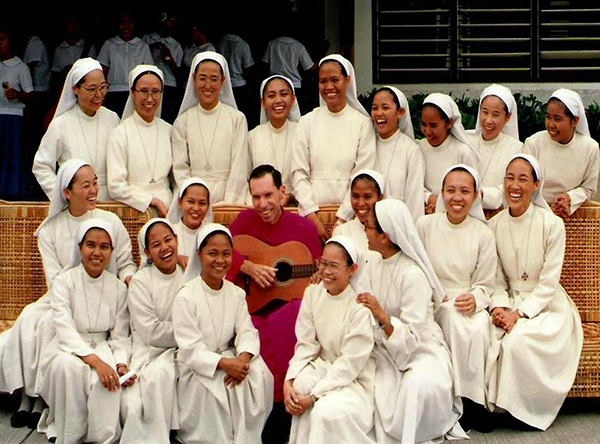
Father sought women willing to dedicate their lives to God in the service of the poor, founding the Sisters of Mary. “When you pray,” he told the sisters, “you only have to ask for two things: You should ask for the light to see the will of God, and you have to ask for the courage to be able to do the will of God.”
Truly, Fr. Aloysius was not unlike St. Faustina who discerned God’s will as most important. As St. Faustina wrote in her Diary:
I accept everything that comes my way as given me by the loving will of God, who sincerely desires my happiness. And so I will accept with submission and gratitude everything that God sends me. I will pay no attention to the voice of nature and to the promptings of self-love. Before each important action, I will stop to consider for a moment what relationship it has to eternal life and what may be the main reason for my undertaking it: is it for the glory of God, or for the good of my own soul, or for the good of the souls of others? If my heart says yes, then I will not swerve from carrying out the given action, unmindful of either obstacles or sacrifices. … And if I learn that something flows from my self-love, I will cancel it out right from the start” (Diary of Saint Maria Faustina Kowalska, 1549.)
Today, the Sisters of Mary number more than 300 and have extended Father’s legacy beyond South Korea to serve the poorest of the poor in the Philippines, Mexico, Guatemala, Brazil, and Honduras. In 1981, Father founded the Society of the Brothers of Christ with the same mission.
Not surprisingly, Fr. Al was nominated for the Nobel Peace Prize twice, in 1984 and 1992, in recognition of his work creating extensive, Catholic-based systems of care that rescued thousands of orphans and destitute children around the world.
Tried his best
Father Al was diagnosed with ALS in 1989, which he endured with a spirit of joy and great patience. In his last days, he told his sister that he would be happy if his gravestone read, “Here lies Father Al. He tried his best for Jesus.” He died in Manila, Philippines, on March 16, 1992, at the age of 61.
For his life of heroic virtue, Fr. Al was declared “Venerable” by Pope Francis in 2015, a testament to his unwavering faith and tireless dedication to serving the poorest of the poor.
Venerable Fr. Aloysius Schwartz, pray for us!
{shopmercy-ad}